
Blog
Layoffs as Redistribution: Building Resilient Production
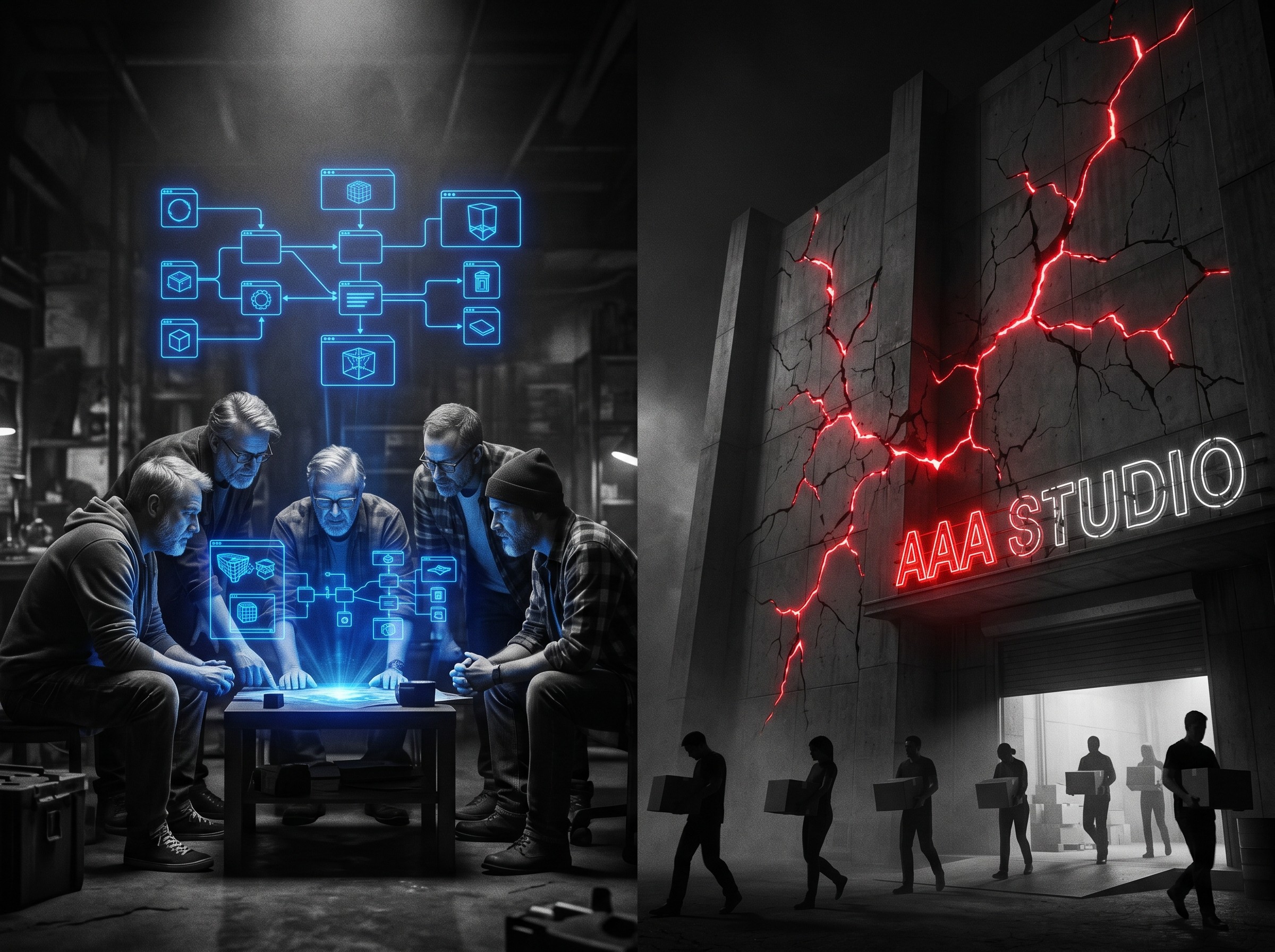
Here’s an idea I keep coming back to: what if layoffs didn’t just destroy talent, but actually redistributed it into stronger, more resilient production systems?
It’s not a fantasy.
The US economy has been built on exactly this principle — take disruption and turn it into a wave of new businesses.
Small, independent teams don’t just survive here; they end up driving entire industries forward.
And I genuinely believe game development could be doing the same thing, if we choose to see it that way.
Because when layoffs hit our industry, what really disappears aren’t just names on a spreadsheet. What vanishes are working production units. These are teams that already know how to ship together. They understand pipelines inside out, they’ve learned to navigate constraints, and they know what real delivery demands. That kind of collective muscle memory is painfully hard to rebuild once it’s lost.
And here’s something equally important that we rarely talk about: studios don’t lose relationships after layoffs.
They know exactly who they would trust to work with again. That knowledge doesn’t evaporate.
So instead of letting these teams fragment and scatter, the market already suggests a natural, logical path forward:
Small, senior-led independent studios that are built to last.
Flexible collaboration models where those studios contribute to multiple projects at once.
A way for them to remain active participants in production pipelines, not occasional helpers.
I’m not describing “outsourcing vendors.” I’m talking about production-ready units that come with both deep expertise and pre-existing demand for their skills. They don’t need to learn your culture from scratch — they’ve often already been part of it.
The beautiful part is that this doesn’t require some massive central coordination. It’s just a more intentional extension of how the industry already works when it’s at its best.
And let me be clear: this isn’t about replacing internal teams. It’s about extending them — giving them the kind of surge capacity that doesn’t cost you speed, context, or continuity. Right now, the default mode is the complete opposite. We break systems that were working, then spend months (and millions) trying to rebuild them from scratch, often with less cohesion.
External development has quietly stopped being just support. It’s becoming infrastructure — the connective tissue that keeps production going when everything else feels unstable.
So the real question we should all be asking ourselves now is: are we going to structure this shift intentionally, or are we going to keep destroying production capacity and then buying it back later at a premium? Because, honestly, that’s exactly what the industry is doing today, and we can’t afford to pretend otherwise.