
Blog
AI Generates 1000 Options. Who Filters?
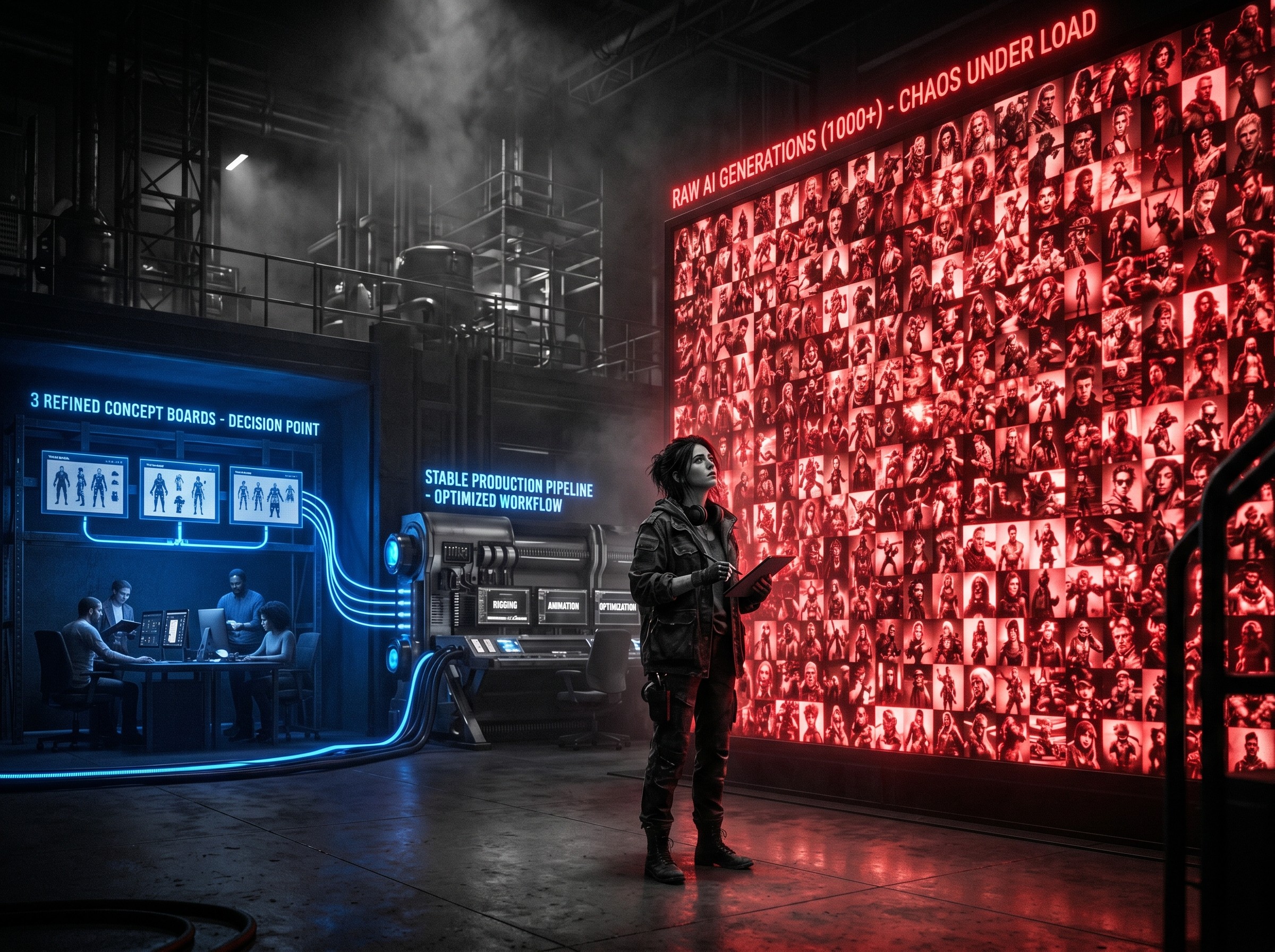
One thing I increasingly wonder about is whether the future of AAA art direction becomes less centralized over time.
As production complexity grows, many studios are running into the same operational bottleneck: too many creative decisions flowing through too few people.
Historically, one of the hidden functions of senior external development was not simply producing assets - it was reducing ambiguity before production problems appeared.
Experienced external teams rarely brought art directors hundreds of raw options.
Instead, they presented a small number of carefully filtered directions already evaluated against: animation feasibility, gameplay readability, technical constraints, shader complexity, grooming requirements, optimization realities, modularity, downstream production cost, and implementation risk.
Those “3 options” were never just concept art.
They were compressed production intelligence.
Now AI can generate thousands of variations instantly.
But generation speed creates a new challenge:
human decision-making does not scale at the same rate as content creation.
And the closer production moves toward implementation, the more expensive unresolved ambiguity becomes.
A concept decision made early can later affect: rigging stability, animation quality, texture memory, review cycles, gameplay readability, production schedules, and overall pipeline efficiency.
In some industries, broader production-aware contribution across trusted senior and mid-level teams has increased adaptability and diversity without weakening brand consistency.
Games may gradually move toward a similar operational model: not by removing artistic leadership, but by distributing certain layers of production-aware creative decision-making across embedded senior teams already operating inside pipelines.
Ironically, AI may not reduce the value of senior production teams.
It may increase the importance of the people capable of reducing noise, removing guesswork, predicting downstream consequences, and helping large productions converge toward stable creative decisions faster.