
Blog
AI Layoff Trap: Why AAA Values Outcome Owners More
Everyone is discussing “The AI Layoff Trap.”
It frames AI-driven layoffs as a coordination failure:
each company optimizes for itself, but collectively erodes demand.
It’s a clean and important model.
But from what I see inside production, something else is happening.
AI isn’t removing demand - it’s compressing it toward fewer, higher-responsibility roles.
The real shift isn’t “jobs disappearing.”
It’s that only people who can own outcomes end-to-end remain valuable.
That’s not a collapse. It’s a redistribution of where value sits in the pipeline.
And this shows up very clearly in real production.
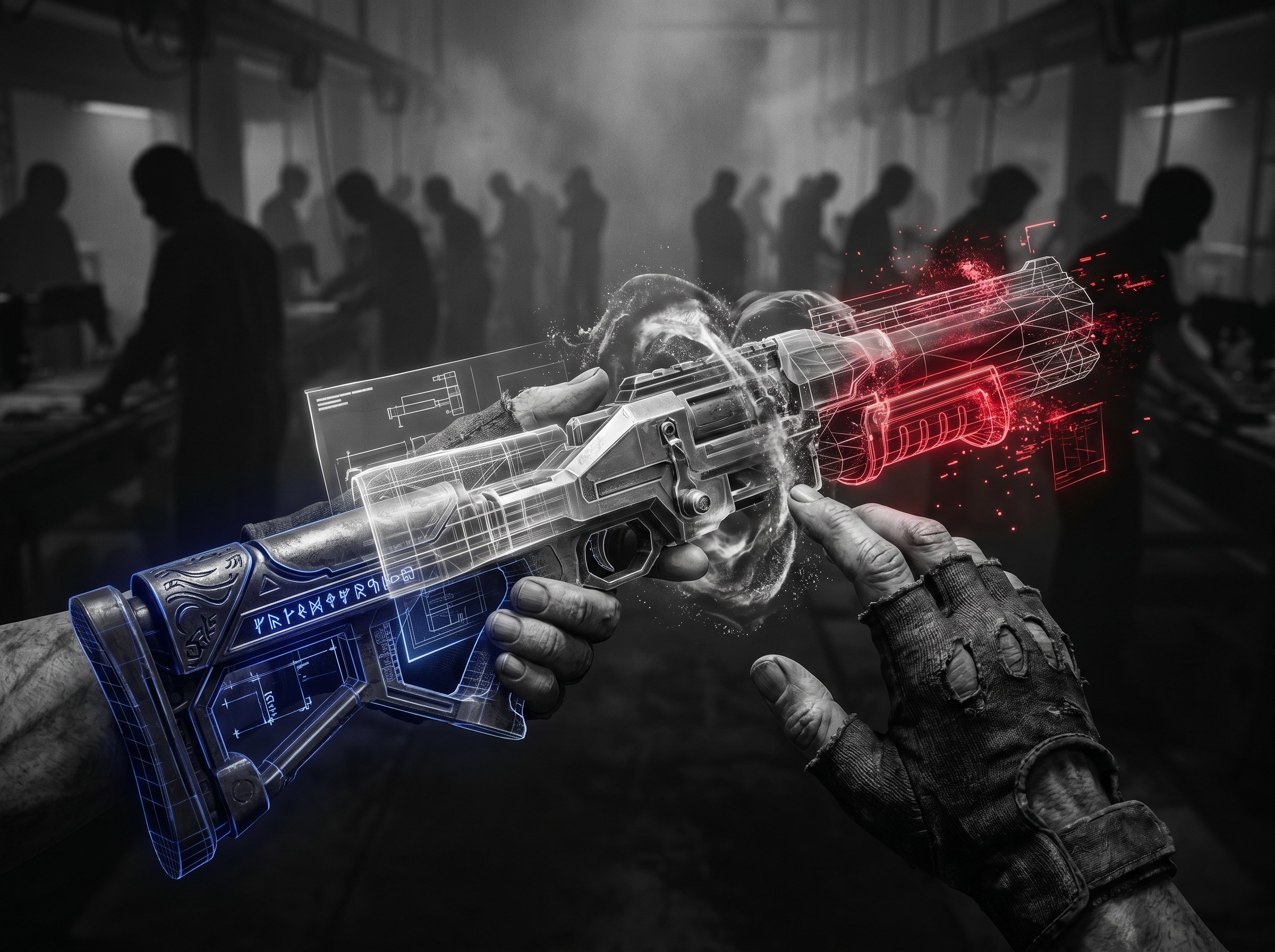
On one AAA project, the first-person magical weapons were left until the very end.
They had already been attempted by other vendors - and didn’t land.
On paper, it looked like a standard asset task.
In reality, it was one of the most critical parts of the player experience.
These weapons sit directly in front of the player, constantly in motion.
They carry a big part of the spectacle - and if they don’t feel right, the whole system falls apart.
What made it complex wasn’t just the asset itself.
We had to:
translate guess work into a convincing 3D reality
anticipate how it would interact with VFX in real time
ensure consistency across multiple variations while maintaining gameplay clarity
At that stage, adding more people wouldn’t have helped.
The work required fewer people - but with the ability to think across concept, modeling, materials, and VFX integration at once.
That’s where the project shifted from “asset production”to owning the outcome.
And that’s why, when I read models about AI compressing work, I see a different pattern in practice.
Execution can be accelerated.
But the layer where everything has to come together - where decisions compound and impact the final experience - that layer doesn’t disappear.
It becomes the bottleneck.
And that’s exactly where the value concentrates.
At Swame, this is exactly where we operate - not as a capacity vendor, but as an embedded production partner, stepping in when the pipeline needs to be stabilized, not just filled.